
Honey's carbon footprint
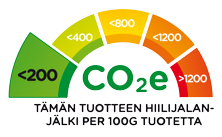
The CO2e label found on our jars of Finnish Flower Honey and Finnish Traditional Crystallized Honey indicates the honey's climate impact. When calculating the so-called carbon footprint, the entire production chain of the honey, from primary production to the store shelf, has been taken into account. The carbon footprint of the honey is 125 grams per 100 grams of product in a 450g jar and 130 grams per 100 grams of product in a 200g jar. With the color-coded scale, the honey's carbon footprint is clearly in the green, indicating that the honey is a very low-emission product.
The carbon footprint of Finnish floral honey and Finnish traditional crystalline honey is 125 grams per 100 grams of product in a 450g jar and 130 grams per 100 grams of product in a 200g jar.
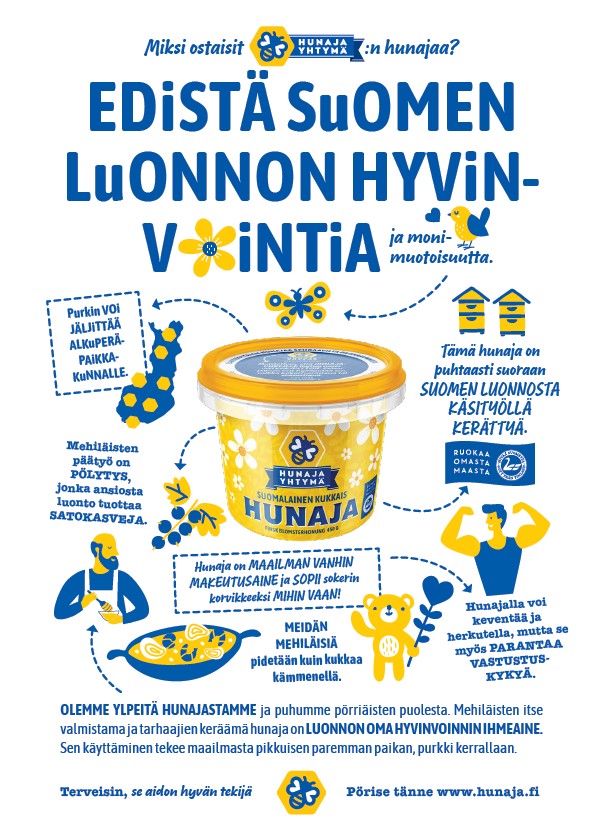
The ecological footprint is being studied with a known metric.
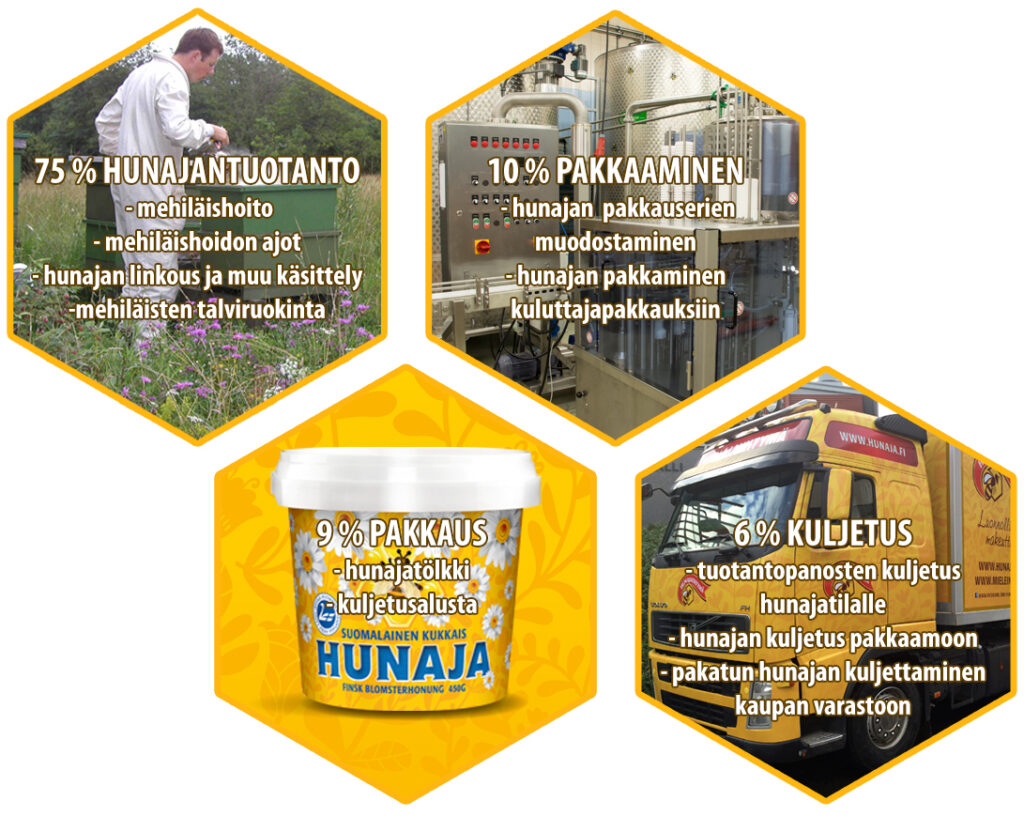
The CO2e meter used in food has been developed by Raisio Plc. The indicator easily shows the size of a product's carbon footprint using color coding: green colors indicate low emissions for the product, while yellow-orange colors indicate a larger carbon footprint. We first implemented Raisio's developed carbon footprint label in the summer of 2010 on our best-known product, Suomalainen Kukkaishunaja. The chart below shows how different production stages contribute to the honey's carbon footprint.
Explore the chart below to see how different production stages contribute to its creation.
A carbon footprint as a future goal
The Honey Cooperative started in the summer of 2021 Ekokompassi Project. The purpose of the project is to improve and enhance the environmental responsibility of the operation. One of the Honey Cooperative's goals is to explore the establishment of a Carbon Wingprint, meaning to determine the positive environmental benefit of honey per jar.
Honey is a product with a small carbon footprint, but in reality, honey consumption has a strong positive effect on the environment. For this reason, through the pollination effect of bees, the carbon footprint of honey is practically positive. The significance of bee pollination work is estimated to be as much as 60 million euros in Finland, so it is practically possible to define a positive environmental impact through the carbon wingprint for every spoonful consumed.